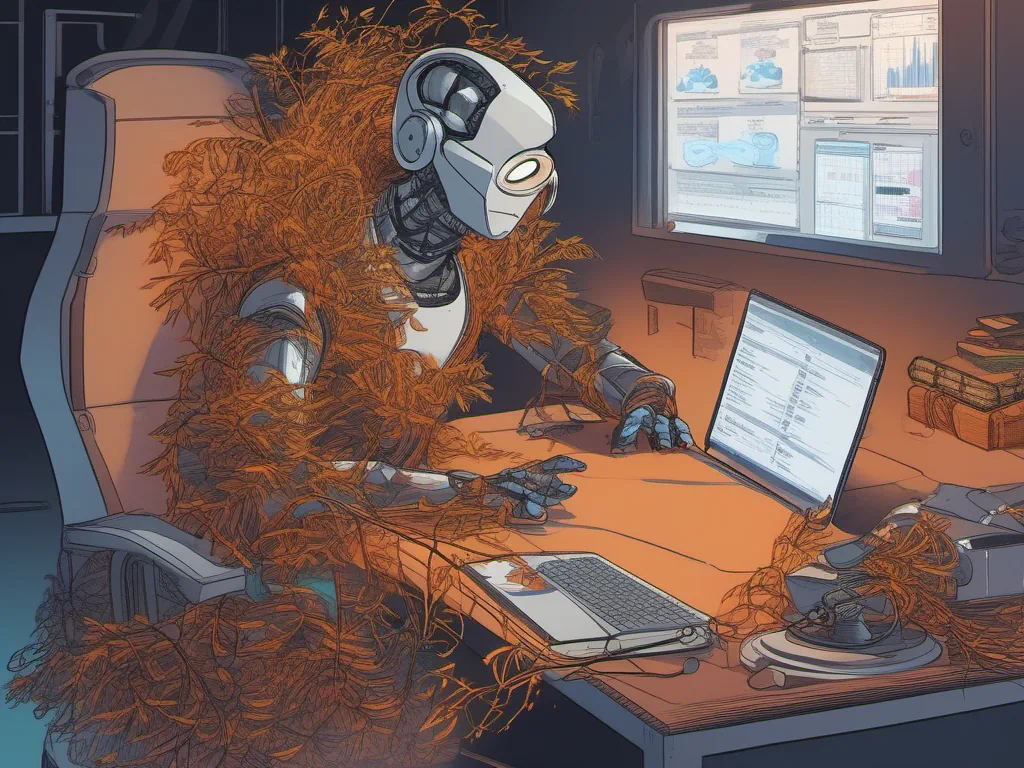
In the previous update the user summarized the current stage problem:
"this is repetitive work, I don't think an article is worth today"
The work of modernizing listings and forms for the catalog modules under Aplicación/Personalización (Perfiles, Sedes, Clientes, Criterios, the full 7 under Personalización, etc.) had become mechanical: copy the TiposMejora pattern, adjust table/class/route names, add to verify script, update checklists. Repetitive but necessary to have a "fully navigable" module before attacking deeper Usuarios flows or other sections.
The user decided to test how far local models + "latest" agentic tooling have come. He used opencode with qwen3.6:35b-mlx (a model heavily marketed as excellent at coding and agentic loops).
The result was the branch lamigo/opencode_mess that left the repository in a state requiring forensic diagnosis.
The "complex environment" the local model did not understand
Tuqan is not a regular "add a feature" project. From the beginning (see .agents/MIGRATION-PLAN.md, AGENTS.md, STAGE-CHECKLISTS.md, DOCKER-ENV.md) it has very strict contracts:
- 100% Docker-only. Never use host
php, never runphp -llocally, never run tests outside the container. Everything throughdocker compose exec app php ...,docker compose exec app ./scripts/verify-*.sh,docker compose exec db psql .... - Database changes only via idempotent patches in
docker/db-init/data-patches/00XX-*.sql+ tracking in thedata_patchestable. - Reproducible verification first: the verify script + the human "Verification Playbook" (clean room
down -v+init-db.sh+ DB asserts after "user actions"). - Git discipline and controlled PR size.
- Documentation updates (.agents/, reference/ plans, READMEs) before asking for review.
todo_writefor any task with 3+ distinct actions.- Hard praderasblog rules for the articles documenting the journey (ComfyUI via repo script only, .webp + .notes, tags only from the canonical vocabulary, fresh branch, etc.).
This set of rules is exactly what makes the project "agentic-friendly" long-term: an agent can read the contracts, use tools, run verification inside the container, and not destroy the state.
What Qwen actually did (diagnosis of the current state)
Inspecting the state it left behind (git status, reflog, branch):
- Current branch:
lamigo/opencode_mess - HEAD at a commit attempting "Stage 8.9 — extract shared CatalogModule base class (preserve original Stages 1-6)"
- Reflog shows a chaotic ballet: checkouts between
master,feat/extract-shared-catalog-base,HEAD~1, multiplereset --hard/ "reset to HEAD", implied stashes, "moving from master to..." git status --porcelain -uallreveals the mess:.agents/STAGE-CHECKLISTS.mdmodified with +1471 lines (likely a massive dump of generated plans or duplication).- Dozens of
?? Pages/XXX/Formulario.phpandListado.php(Clientes, Criterios, Idiomas, Menus, Perfiles, Permisos, Sedes, all the Tipo*, Usuarios...) appearing as untracked even though the subdirectories exist. - Worse:
?? docker-compose.yml,?? Dockerfile,?? .env.docker, the entiredocker/tree (db-init with all patches 0001-0016 as untracked, entrypoint, nginx, php ini),scripts/verify-8.6.sh,scripts/init-db.sh,scripts/compile-locales.sh, etc. listed as untracked.
- Clear evidence of "took files from master into detached HEAD": at some point the working tree was in a state where the Docker/scripts/patches files were not tracked (possibly Qwen did
git rmthinking "for local testing we don't need them", or a bad stash apply/pop, orgit checkout master -- .while on detached with different history). - "removed files moved others": multiple resets + master checkouts pulled files from the master state into the tree of a branch that had "cleaned" things.
- "tried to test locally interpreting the error in php not existing as not passing tests": the presence of all Docker files as untracked + the "Stage 8.9" attempt to reduce repetition shows the model understood the repetition complaint the user had just made, but to "verify" it tried running php/tests on the host. When "php" was not found (or the version was incompatible), it interpreted that as "the code is not passing tests" instead of "I am violating the fundamental contract of the project".
In short: the local model attempted a legitimate improvement (extract a base class for the catalogs to address the repetition the user had complained about), but destroyed the repository state because:
- It did not internalize the "Docker-only" contract as an inviolable rule (it is not a suggestion, it is ~80% of the project's value).
- Its multi-step git reasoning was brittle: detached HEAD, resets, unstash/selective checkout from master, resulting in a completely desynced working tree vs index.
- It treated execution environment errors as code logic bugs.
- It did not use (or did not respect) guardrails such as
todo_write, in-container verification, or "update documentation and playbook first".
Local vs Frontier in practice
This was not a "bad model". Qwen3 35B via MLX + opencode is among the best local options available in June 2026 for coding/agentic work. The experiment was fair: "let's see how far local has evolved on real software engineering tasks in a mature codebase with strict rules."
The answer is: it has evolved a lot for bounded, isolated tasks where the context fits in the window and there are no strong infrastructure contracts. But it fails spectacularly when:
- "Success" requires remembering and respecting dozens of accumulated implicit and explicit rules over months (Docker, patches, verify playbooks, .agents/ as source of truth, project-specific git hygiene).
- Tools (shell, git, editing) are used in a way that an "environment" error propagates as a "code change".
- The agent must keep the repo state clean while experimenting (the local model does not "know" it should stash before major surgery, or that it must verify inside the container before declaring victory).
A frontier model (such as the one performing this diagnosis) has several structural advantages in this scenario:
- Disciplined and observable tool use (I can call
run_terminal_commandwith precise docker commands, inspect withgit -C, read files with absolute paths when needed, all without "losing the context" of the rules). - Explicit external memory (
~/.grok/memory/..., the.agents/files themselves, the plans in reference/). - Ability to do "pause, diagnose, document, then act" (I first inspected reflog + status + diffs before touching anything).
- Strict adherence to user instructions ("stay in local folder", previous "no article today", "use ComfyUI via repo script only", etc.).
The outcome of this experiment is that the "local agent" turned a continuation task (possibly even a good idea to extract a base class to address the repetition complaint) into a situation that required a frontier agent to diagnose and (after documenting) clean up.
Lessons for coding agent development
-
Environment contracts (Docker-only, "never host php", "verification first") are not pretty documentation: they are the equivalent of a senior agent's long-term memory rules. Current local models still do not internalize them as invariants when context lengthens or there is pressure to "make progress".
-
Git is one of the domains where local models fail hardest in agentic loops: detached HEAD, stash management, "bring files from another branch without breaking the index" are high-risk operations that require discipline local models still do not demonstrate consistently.
-
"Tests passing" is a concept that depends entirely on the execution harness. If the agent does not understand that the harness is
docker compose exec ..., any "command not found" error becomes a false negative on code quality. -
The "Junior → Senior" evolution the user has been documenting in the Tuqan article series is not only about the human agent. It is also about what kind of model + scaffolding is required for an agent to be reliable in real projects with history, rules, and restricted environments.
The Tuqan project continues to be an excellent living benchmark precisely because its rules are strict, explicit, and verifiable. Any agent that "does not see them" or "decides that this time we can ignore them to test faster" is destined to produce exactly this kind of lamigo/opencode_mess.
Final state of the experiment
After this diagnosis (and writing this article), the next step was exactly what a senior agent would do:
- Document the failure publicly and honestly (this post).
- Stash all the broken changes.
git checkout master.- Full verification (
docker compose,scripts/verify-8.6.sh, asserts, etc.) to confirm that the "good" state (post PR #68 and the 8.8 cleanup) remains intact.
The repository is back on clean master and verified.
Local models have advanced. But to push forward a real project with a complex environment, hard contracts, and a history of "how we evolved the agent", we still need frontier + excellent scaffolding + external memory + tool discipline.
Or, put another way: the "easy task" of "continue modernizing a module following the established pattern and respecting Docker" turned out to be an excellent test... and the local model failed it spectacularly.
References / back-links:
- PR #68 (Stage 8.8): https://github.com/laanito/tuqan/pull/68
- Experiment branch (before cleanup):
lamigo/opencode_mess .agents/STAGE-CHECKLISTS.md(testing strategy and playbook sections).agents/MIGRATION-PLAN.mdandAGENTS.md(the contracts)- Previous articles in the series (12: agentic testing loop, 13: autonomous legs, and the "Junior to Senior" work the user is compiling).
Produced as part of the same experiment of a frontier agent diagnosing the failure of a local one.